
Waste, Biomass & Bulk Process Cranes
From the bunker.
To the feed hopper.
Overhead grab cranes for waste, loose biomass and bulk materials. Pick up, mix and feed material with a crane and grab selected for your storage and process.
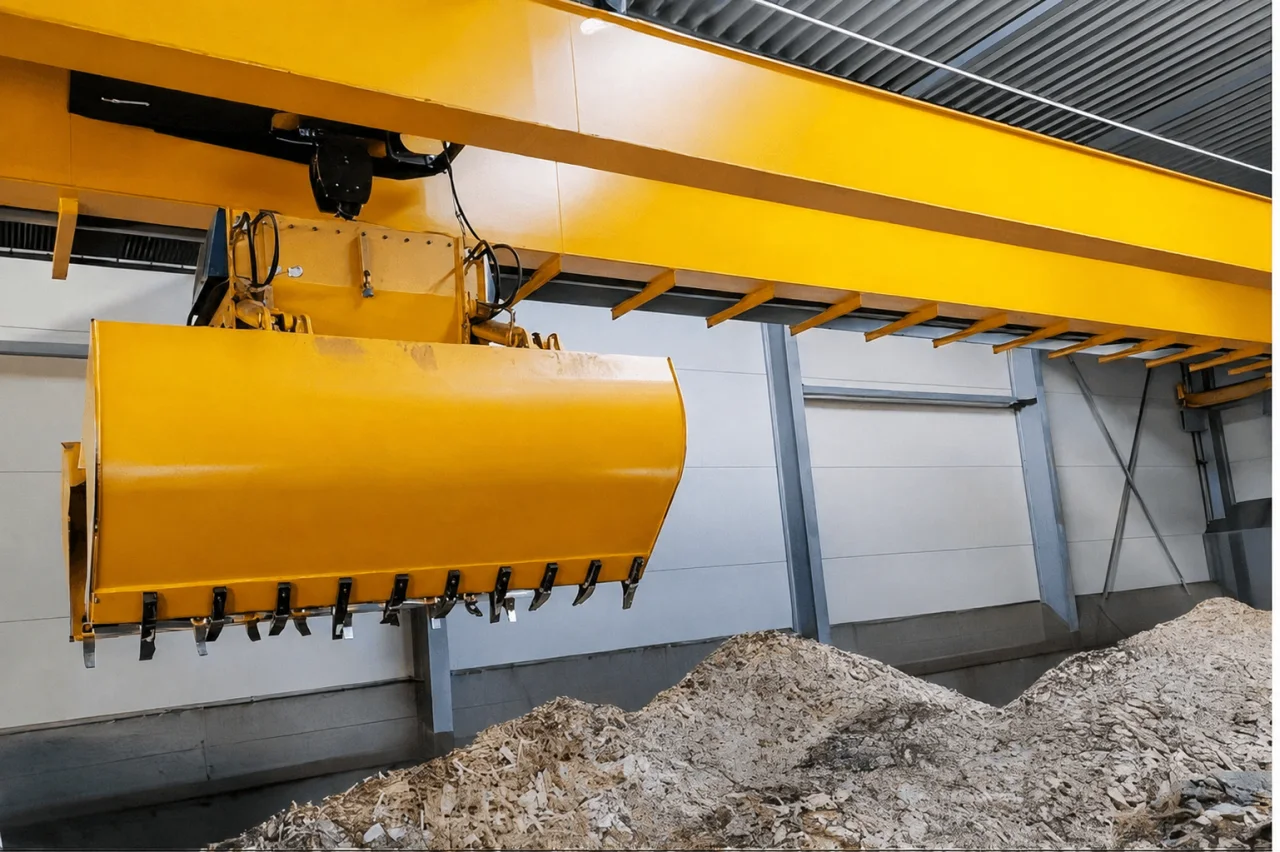
What will the grab pick up?
Four common duties are shown below. The material condition and storage layout determine the equipment, not the industry name alone.
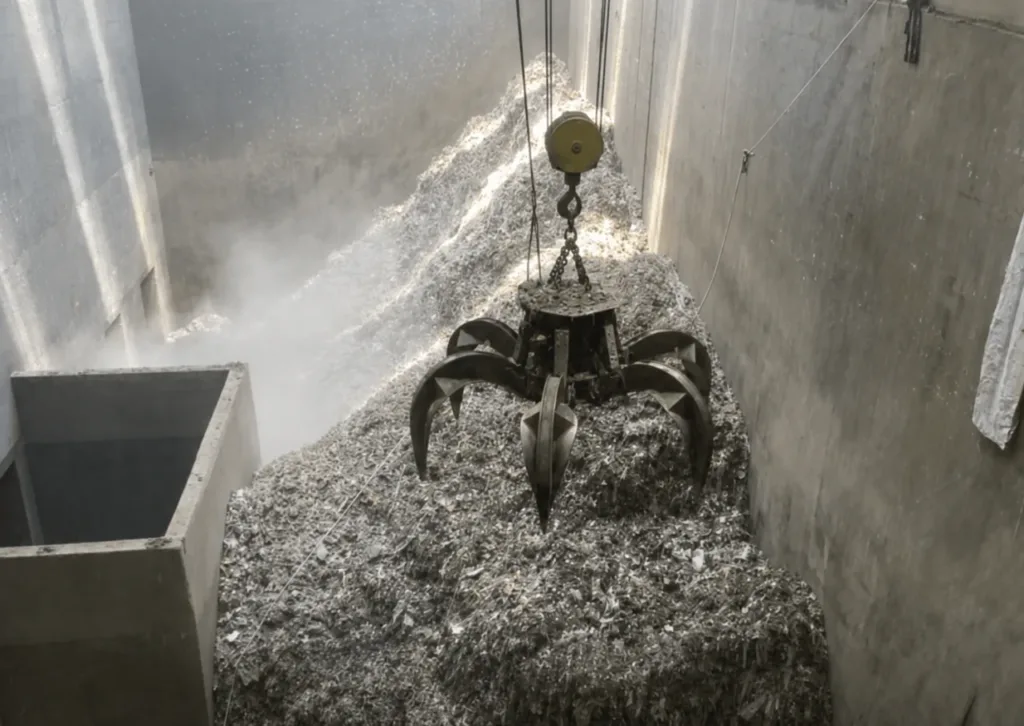
Mixed waste
Clear the receiving area, mix stored waste and feed the furnace hopper.
View grab & site requirements
- An orange-peel grab can handle irregular mixed waste. Check the waste composition and large or tangled pieces.
- Show the receiving doors, storage zones and hopper openings. Mixing and restacking also take crane time.
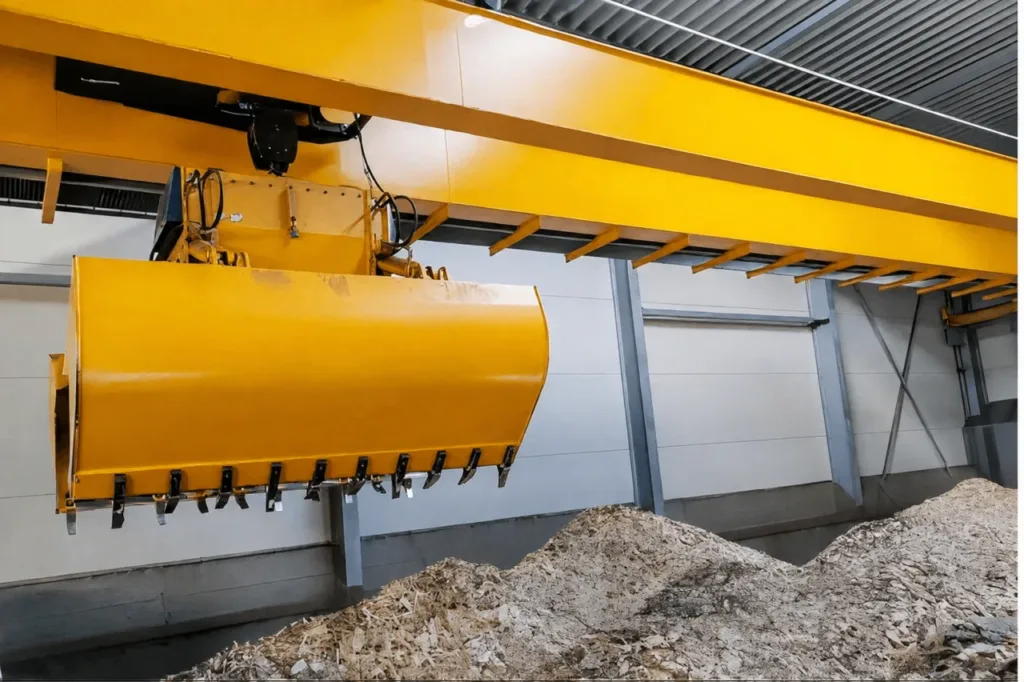
Loose biomass
Move loose fuel from storage to the feed point. Bales need a different handling arrangement.
View grab & site requirements
- Provide bulk density, moisture and particle size for the actual fuel; the material name alone does not define the grab.
- Specify the required feed rate and receiving schedule so storage moves and fuel delivery can be planned together.
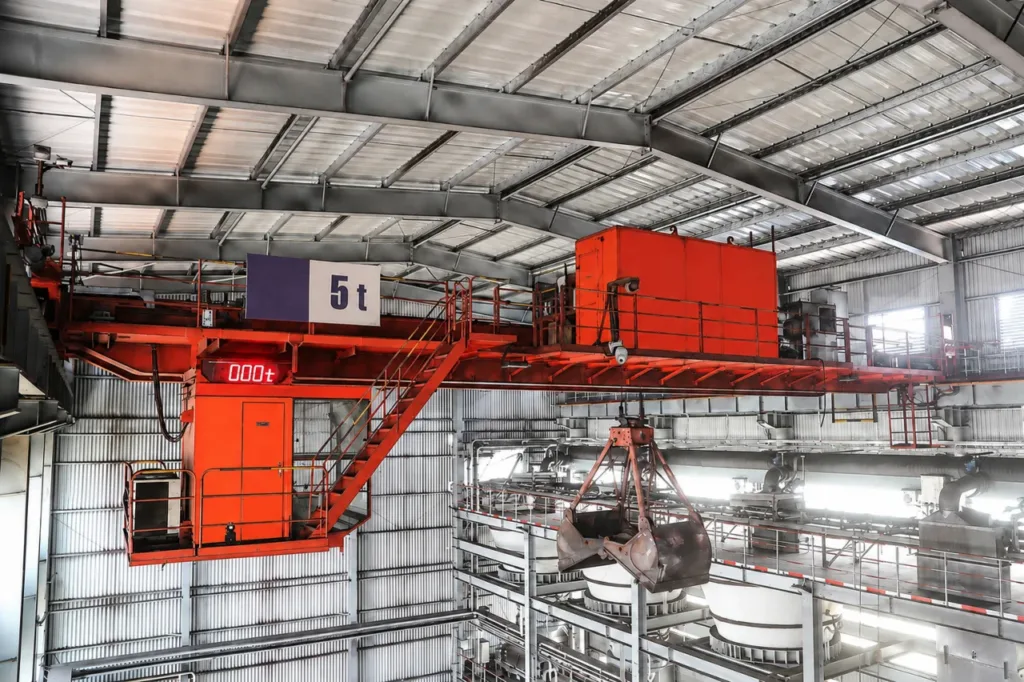
Bulk raw materials
Move ore, coal or sand between storage and process hoppers.
View grab & site requirements
- Match the shell to bulk density, lump size and wear. Grab weight and material payload both count toward the lifting load.
- Show hopper opening dimensions and the discharge height. Check the clearance for the open grab, not just the closed bucket.
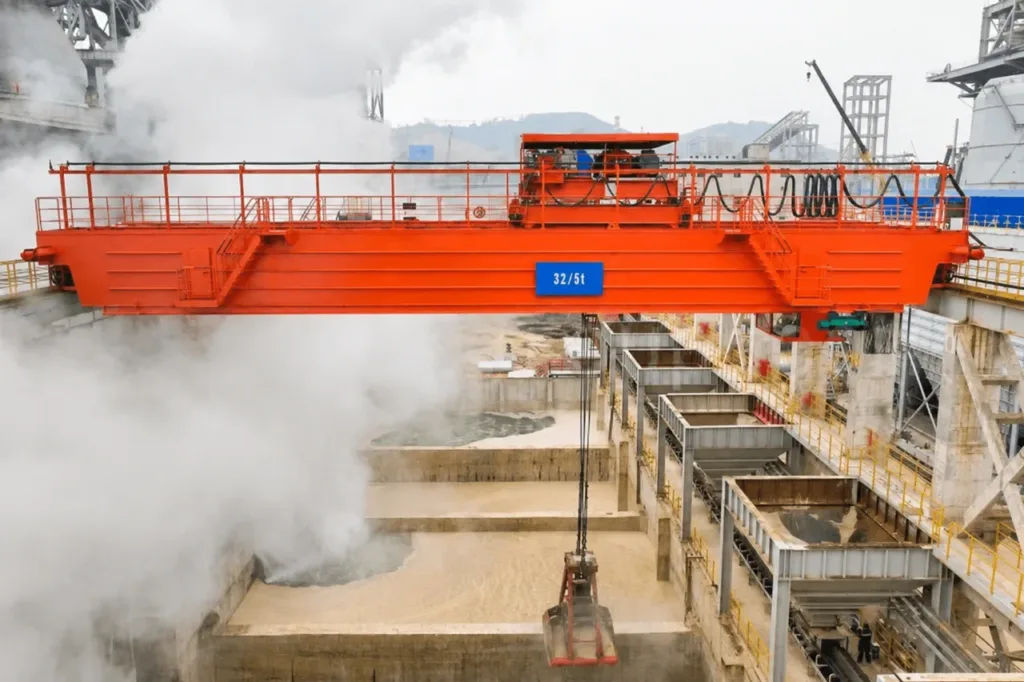
Slag & residues
Transfer suitable solid residues from collection cells. Fine dry ash may require enclosed handling.
View grab & site requirements
- Confirm temperature, moisture and stickiness. A slag-handling photograph does not establish suitability for hot material.
- Identify the container, hopper or next conveyor and the permitted spillage. Molten-metal handling is a different duty.
The grab and crane work as one.
A four-rope mechanical grab needs compatible hoisting and closing mechanisms. It is not a drop-in attachment for every existing crane.
Tines close around mixed material.
The separate tines suit certain irregular materials. A clamshell uses two main shells for suitable loose bulk material. Choose the shape for pickup and containment, then select its drive.
Agree the complete handling scope.
Fissure Tech is your contract partner for the agreed equipment and delivery scope. We coordinate the crane, grab and controls with your bunker and process equipment team.
01Equipment and plant interfaces
The proposal identifies the crane, lifting attachment, controls and hopper or plant interfaces. Manufacturing partners are audited on site before cooperation.
02Site work and commissioning
Runway work, erection, power connections and machine modifications are assigned in the proposal. Installation supervision and commissioning support can be included in the agreed scope.
03Tests and handover
Agree equipment checks and installed handoff trials for the selected duty. Handover includes the agreed drawings, manuals and inspection or test records.
Before you specify the crane.
Feed rate, operating modes and site conditions can change the scope.
01How is the required handling rate checked?
Include pickup, travel, discharge and return time, plus mixing and restacking. State the required feed rate and working hours. Rated lifting capacity alone does not establish tonnes per hour.
02Can the crane feed a hopper automatically?
An agreed control package can automate suitable handling sequences. Define feed requests, level sensing, operating zones and the manual recovery procedure. Automation is a project option and does not remove the need for supervision and maintenance.
03Does a dusty store require an explosion-proof crane?
Dust alone is not enough to select the equipment. Provide the site hazardous-area classification, material information and destination requirements. The crane, grab and electrical equipment must then be selected for the identified conditions.
Show us the material.
Mark the pickup and hopper.
Start with material photos and a bunker or storage sketch. We can discuss the grab type, crane coverage and information needed for a handling proposal. Incomplete drawings are enough to begin.
Discuss your crane- Type, bulk density, largest pieces, moisture and temperature
- Storage zones, hopper openings, travel route and available headroom
- Required feed rate, receiving schedule, operating hours and control mode