
Vacuum Lifting Systems
Grip the surface.
Support the load.
Vacuum lifters for metal sheets, glass, stone and panels, plus tube lifters for repetitive handling. Start with the surface, load shape and movement—not weight alone.
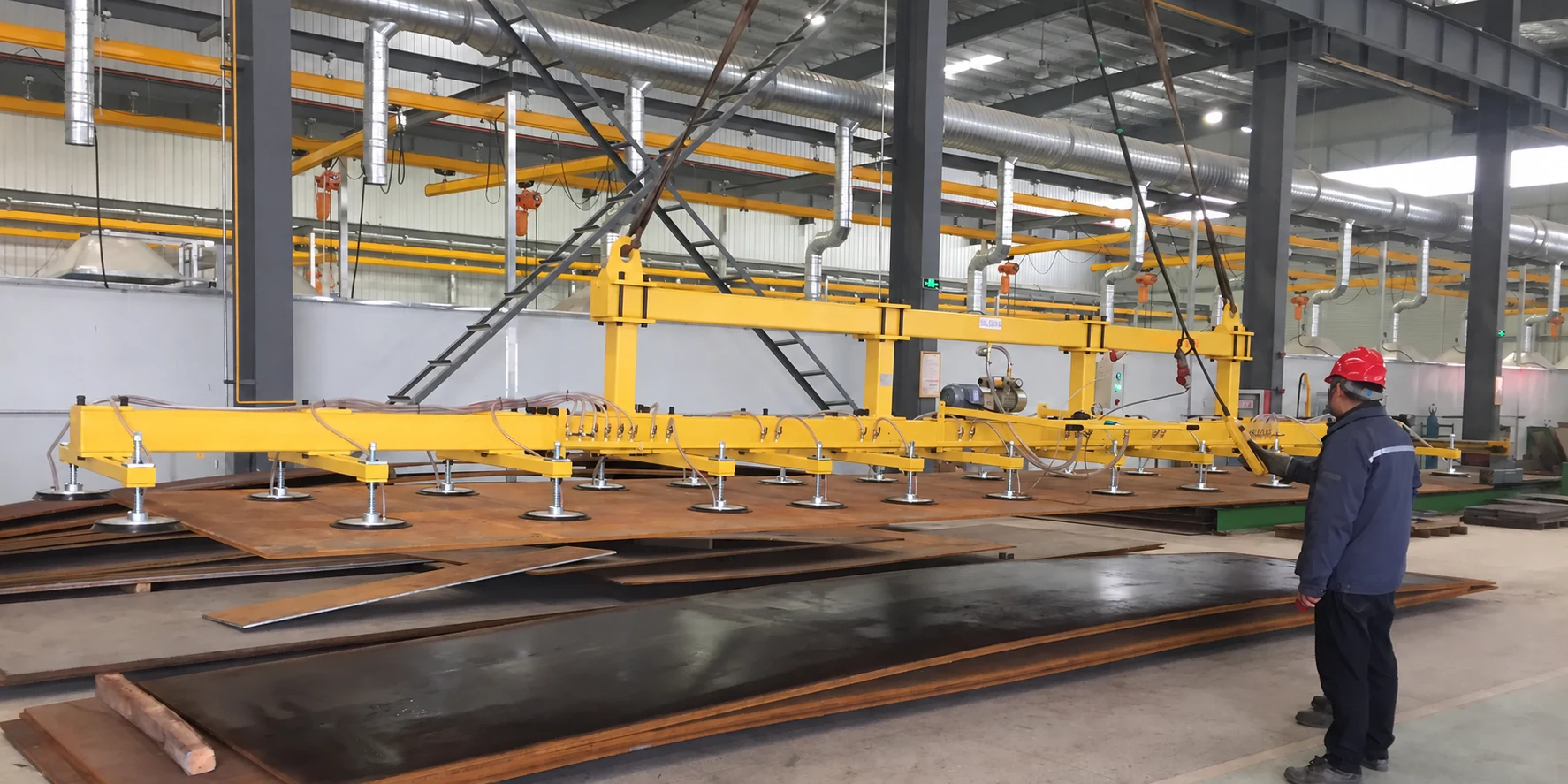
How will the
load move?
For crane-suspended lifters, choose the handling orientation first. Electrical, battery, compressed-air and self-powered designs are supply options within the suitable arrangement.
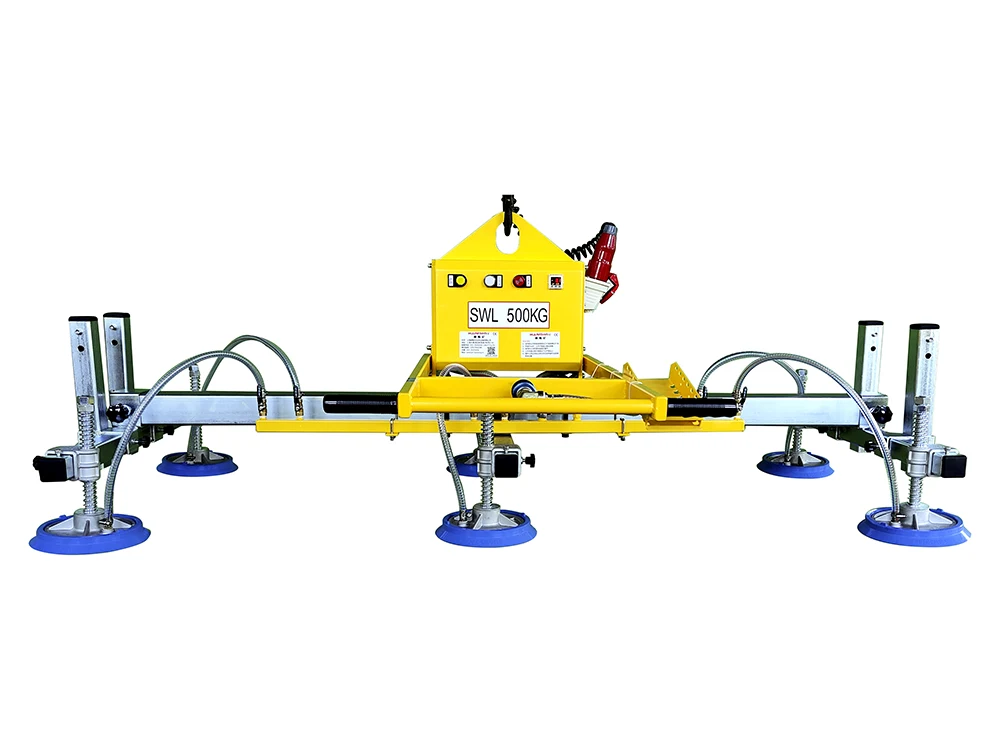
Horizontal lifting
A suction frame grips the sheet while a crane or hoist raises it. Adjustable pad positions can accommodate a defined range of sizes.
Selection details
- Check the smallest and largest sheet, minimum thickness, pad contact and overhang. Flexible sheets need support that limits bending.
- Loading a complete sheet and removing cut parts need different contact layouts. Show the finished parts and scrap skeleton.
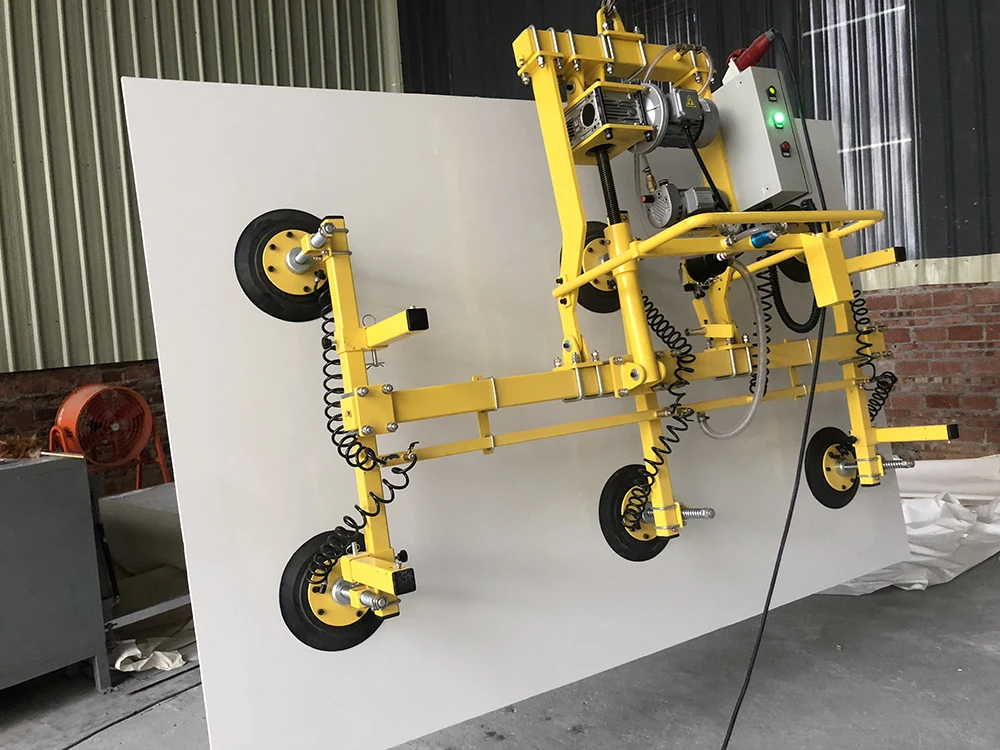
Tilt & rotate
Bring a sheet or slab from a stack to a vertical rack or machine. Specify the required tilt angle and in-plane rotation separately.
Selection details
- Choose manual or powered movement for the task. Horizontal capacity does not establish vertical or tilted capacity; load depth and centre of gravity matter.
- Include the swept space, hook height and final placement. Factory processing and outdoor glazing have different operating conditions.
What will
the pads touch?
Material names alone are not enough. A sample, close-up photos and the pickup position reveal whether vacuum is a practical choice.
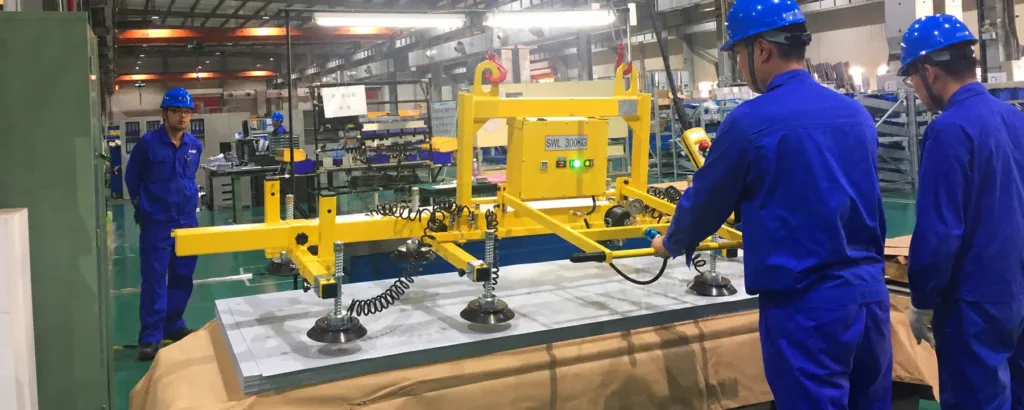
Load the sheet
Steel, aluminium and suitable stainless sheets can be handled without relying on magnetic properties. The surface must still seal reliably.
Selection details
- Give minimum thickness and surface condition. Include oil, coatings, protective film and the possibility of adjacent sheets sticking together.
- Pads need contact on the material that remains. Holes, narrow parts and an irregular skeleton can make the loading frame unsuitable for unloading.
Move between racks
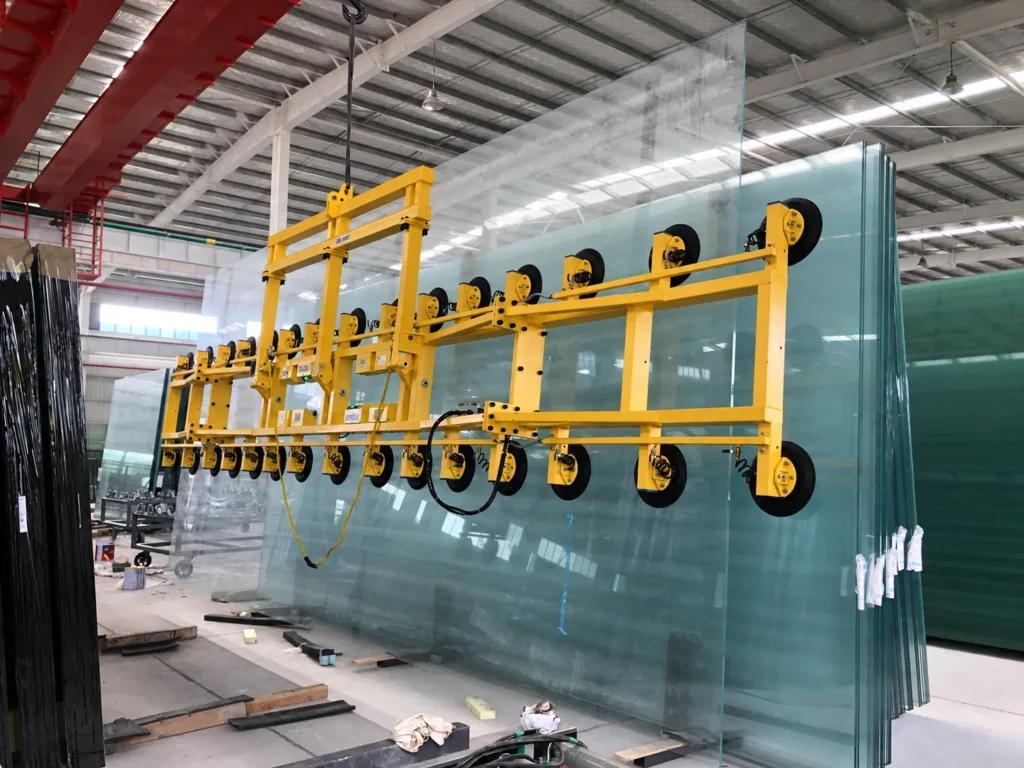
Match the pad layout to the pane, finish and pickup orientation. Processing flat glass is a different task from installing a window outdoors.
Selection details
- Identify coatings, texture, curvature, size and weight. Agree acceptable pad marks and test sensitive surfaces.
- Include access, working angle, weather exposure and the complete lifting method. Do not assume a workshop lifter is an installation lifter.
Check the seal first
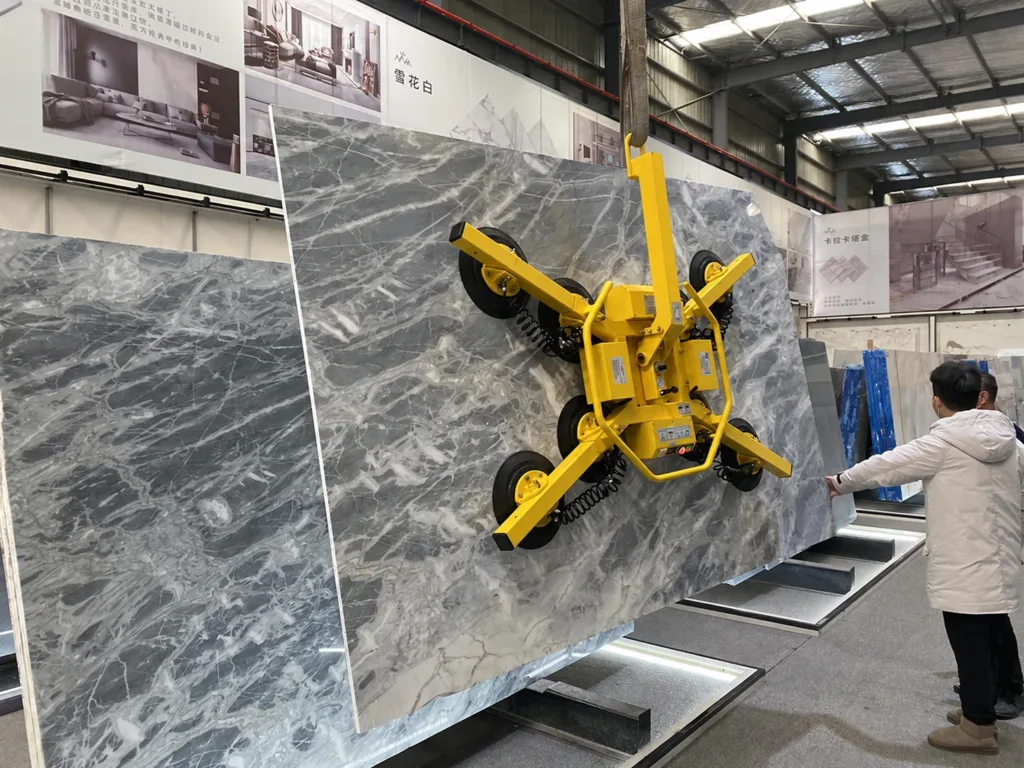
Stone, wood and composite panels vary in roughness, permeability and strength. Pad material and vacuum flow must suit the actual surface.
Selection details
- Give the finish, porosity, thickness and any mesh backing. Rough or permeable material may need a different seal and vacuum source.
- Check leakage, panel flexing and the strength of the skin or coating. A seal on the outer face does not prove that the complete panel can be lifted.
A different way
to raise the load.
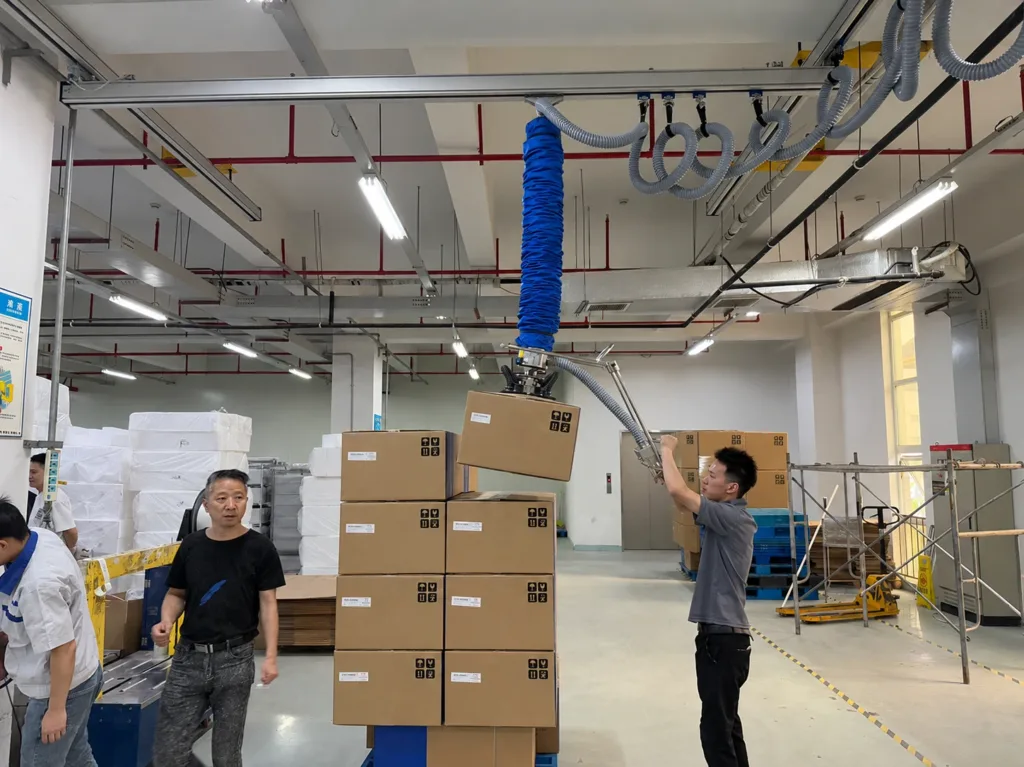
A vacuum tube lifter uses the lifting tube to grip and raise the load. It is commonly considered for repeated box, bag and board handling at a workstation.
Grip and lift through the tube
The operator guides the load with a control handle. Match the gripper to the package or board, and the supporting jib or rail system to the working area.
01When should I consider a tube lifter rather than a crane attachment?
When the task is repeated manual transfer within a defined workstation, assess a tube lifter with the required lifting stroke, reach and package grip. For larger sheet handling or a crane-served route, assess a hoist-mounted attachment. Confirm the actual load and cycle with the supplier.
Will it seal?
Will it stay supported?
Confirm the least favourable workpiece—not just a clean, flat sample. These details decide pad layout, vacuum generation and whether a trial is needed.
| Seal & leakage | Roughness, porosity, holes, joints and texture. Leaky surfaces may require a higher-flow system or a different handling method. |
|---|---|
| Surface layers | Oil, water, dust, paint, film and coatings. The contact layer must remain attached to the load; agree cleaning and mark limits. |
| Size & stiffness | Smallest and largest dimensions, minimum thickness, weight range, overhang and pickup points. Include flexible or fragile loads. |
| Orientation & temperature | Pickup and placement angles, centre of gravity, normal and maximum surface temperature. |
| Single-sheet handling | Explain whether one sheet must be separated from a stack and how pickup will be checked. Vacuum contact alone does not verify separation. |
Specify more
than the suction pads.
Agree the complete attachment, its connection to the crane and its response to loss of vacuum or supply. Safety provisions depend on the selected design and use.
- 01
Frame & pads
Pad number, position, seal material, movement, self-weight and hook connection. Include replacement seals and access for inspection.
- 02
Supply & controls
Confirm the vacuum source, gauge, warning, release protection and the applicable reservoir or non-return arrangement. Define the response to a fault.
- 03
Rating & trials
Request permitted load conditions, drawings, instructions and inspection requirements. Agree representative workpiece trials and required test records.
01Will the load remain held if power or compressed air is lost?
That depends on the design, the load and leakage. Ask for the specified failure response and how it is verified on your workpiece. A reservoir alone does not establish a universal holding time. Tube lifters have different behaviour and must be assessed separately.
02Does a dual-circuit lifter automatically suit outdoor glazing?
No. Confirm the complete equipment rating, load orientation, circuit arrangement, monitoring and operating restrictions for the installation method. The presence of two circuits is not a substitute for an application assessment.
03Will vacuum pads leave marks?
Pad material, glass coatings, temperature and contamination affect marking. State the acceptable surface finish and test a representative sample; do not assume every pad is non-marking.
04Which standards or certificates should I request?
State the destination and project requirements. EN 13155 or ASME B30.20 may be relevant to the agreed lifting attachment and use; the supplier must confirm applicability and documentation. A catalogue reference is not proof for every configuration.
05Are handheld suction cups suitable as crane lifting attachments?
Do not assume so. Use equipment explicitly rated and documented for the intended suspended lifting task, including its connection and operating conditions.
Show us the surface.
Describe the move.
Send a load drawing and close-up photos of the contact face. Include the lightest, thinnest and most difficult workpieces as well as the heaviest.
Discuss vacuum lifting- Material, size and weight range, thickness, finish, coating, porosity and temperature.
- Pickup and placement positions, tilt or rotation, cycle, single-sheet needs and surface-mark limits.
- Crane or workstation layout, headroom, available power or air, working environment and documentation needs.