
Container Spreaders
Match the container.
Fit the crane.
Fixed and telescopic spreaders for lifting ISO containers through their top corner fittings. Choose the box arrangement first, then match the suspension, power and controls to your crane.
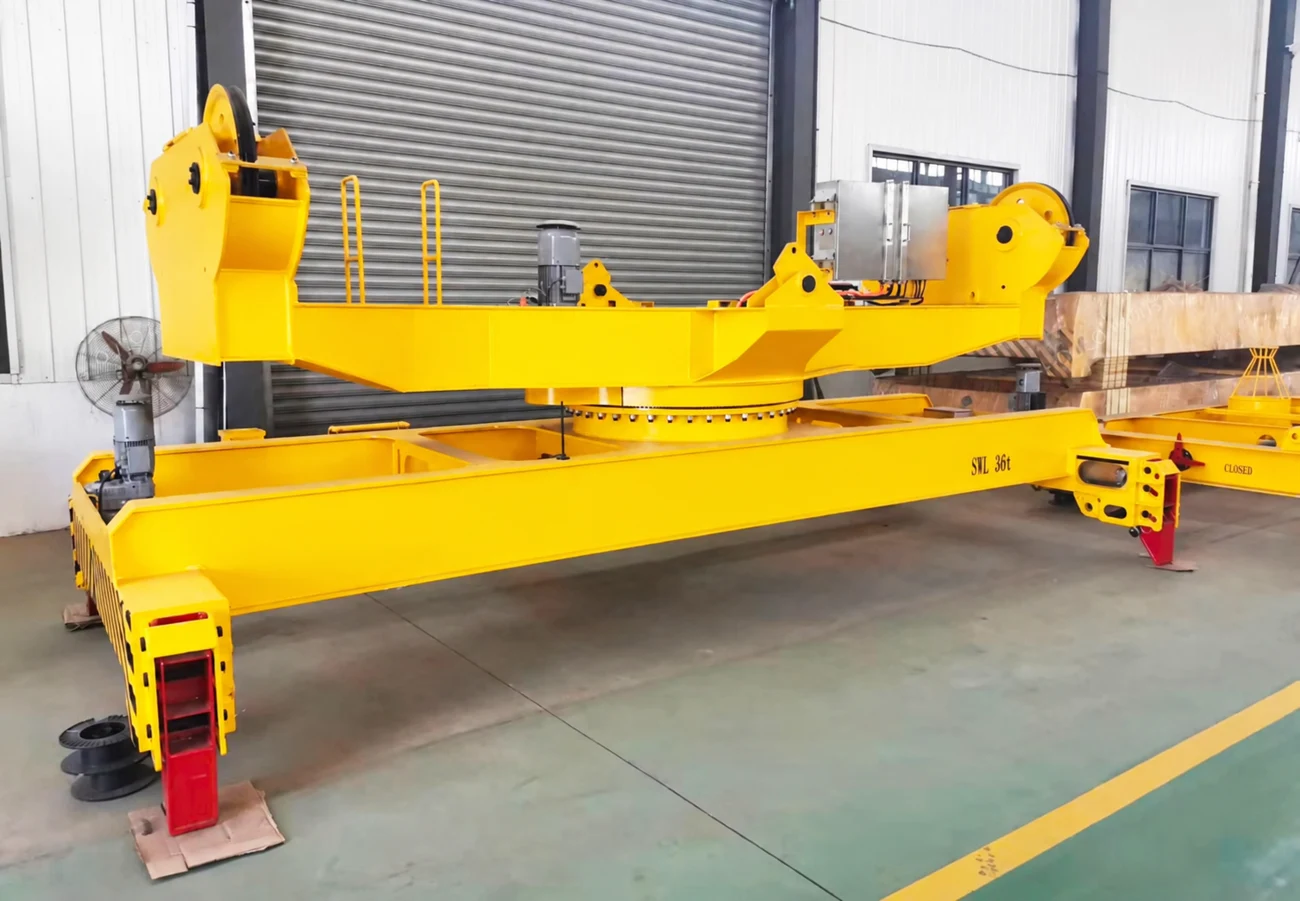
One size, mixed sizes,
or two boxes?
Fixed and telescopic describe the frame. Mechanical, electric and electro-hydraulic describe how its functions operate.
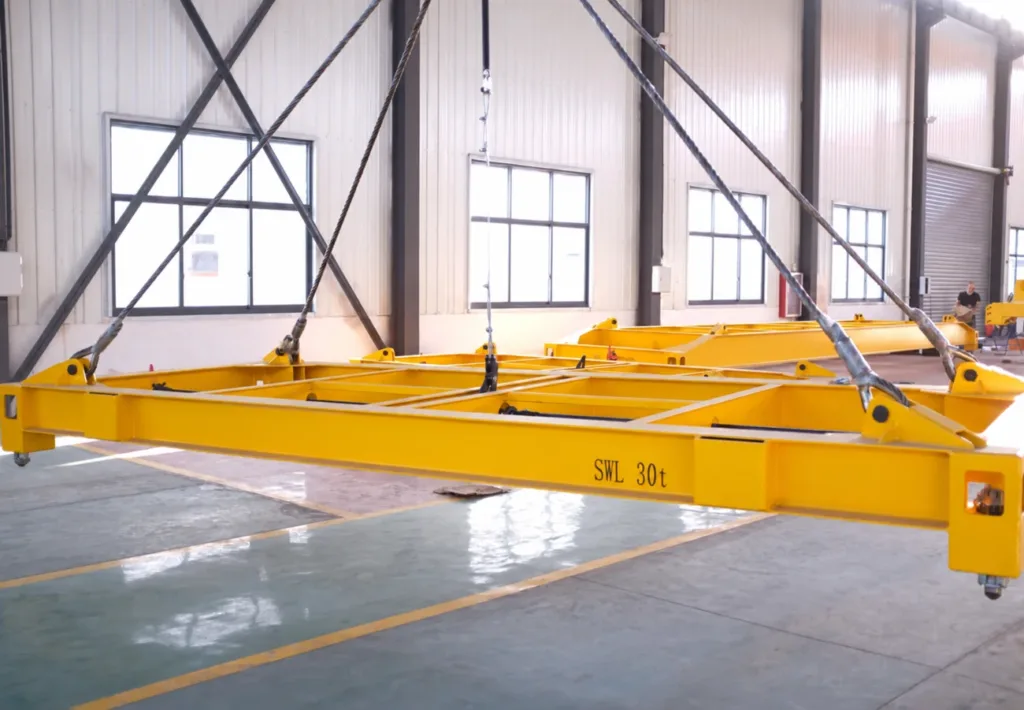
Fixed-size
A dedicated frame for a specified container length. A practical option when box sizes rarely change and handling is occasional.
Selection details
- Some designs use a landing-and-lifting cycle to operate the twistlocks without external power. Confirm the exact cycle and how the operator checks the locked state.
- A 20 ft frame is not a 40 ft frame. Check whether separate frames or an approved interchangeable arrangement is appropriate.
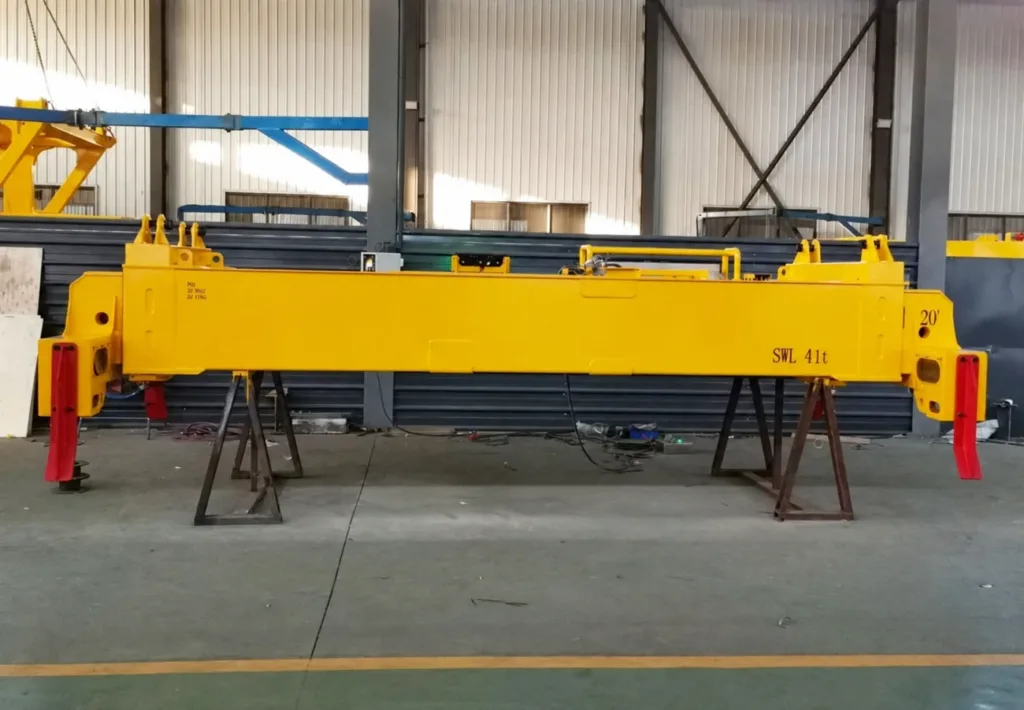
Telescopic
The end beams extend to suit different box lengths. Suitable for repeated handling where changing complete frames would interrupt the work.
Selection details
- Specify every required box length. 20/40 ft arrangements are common; 30 or 45 ft positions depend on the selected model.
- Electric and electro-hydraulic are drive options within this arrangement. Guide flippers, rotation and centre-of-gravity adjustment are configuration choices.
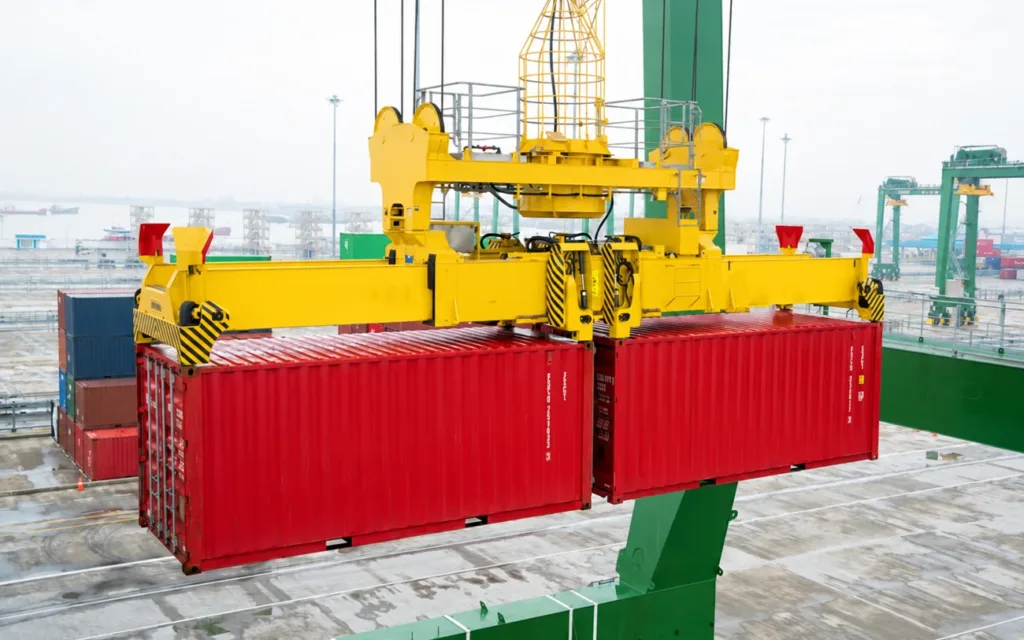
Twin-lift
Additional centre twistlocks allow two 20 ft boxes to be lifted end-to-end in one cycle, with a crane and control system designed for the task.
Selection details
- Check the combined gross weight, weight difference, spreader tare and crane rating. Two boxes do not establish an automatic productivity or capacity increase.
- Fixed-gap and separating arrangements differ. State the gap and whether separation under load is required; single-box modes are model-specific.
Which crane
will carry it?
The same container can be handled by different cranes. Their suspension and operating interfaces are not interchangeable.
- 01
Ports & depots
Check lifting rings, sling geometry, headroom and any rotation arrangement. A mechanical spreader may suit a defined task without a dedicated electrical connection.
- 02
Stacking & transfer
Match the headblock, pins, electrical plugs and position feedback. Replacing a spreader requires the existing interface drawings.
- 03
Quayside handling
Confirm single or twin operation, box guidance, crane interlocks and maintenance access. High-cycle service needs a defined duty and support plan.
When a standard
top lift is not enough.
Protruding cargo and bulk discharge need dedicated attachments and operating checks.
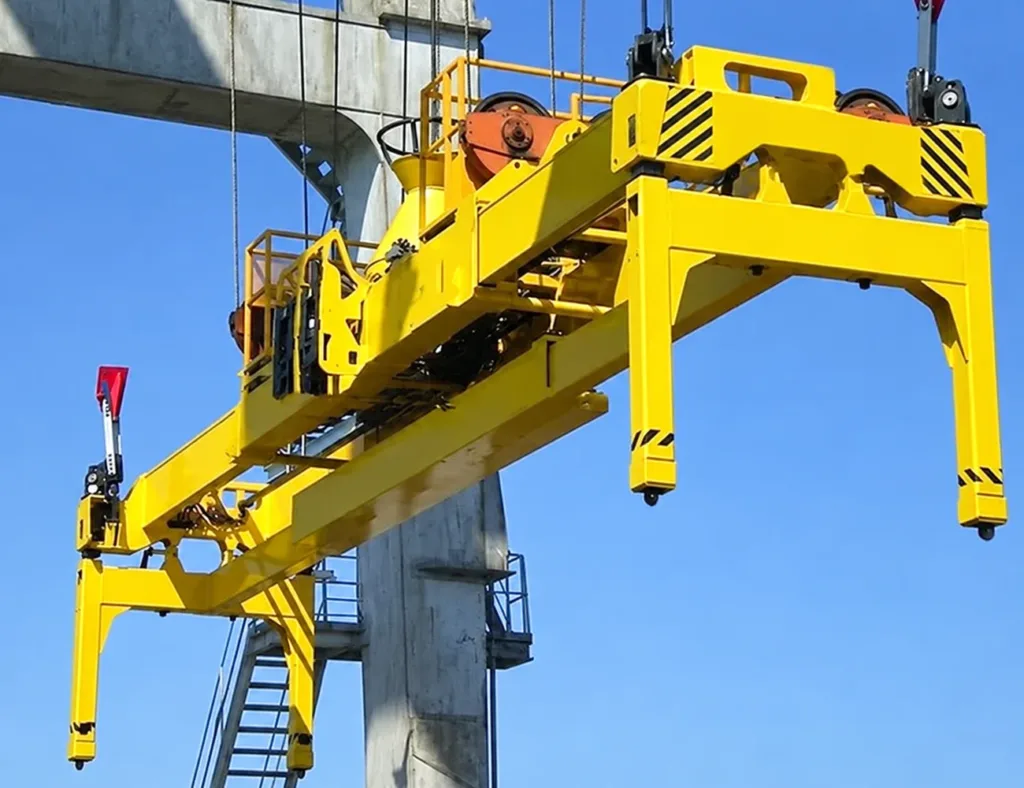
Overheight frames
An extension frame reaches the corner fittings while providing clearance above cargo on an open-top container or flat rack.
Selection details
- Give the protrusion above the corner fittings, cargo width, lifting points and available headroom. A normal high-cube box alone does not imply a need for an overheight frame.
- Confirm the parent spreader connection, lower locks, permitted load and how attachment status is checked.
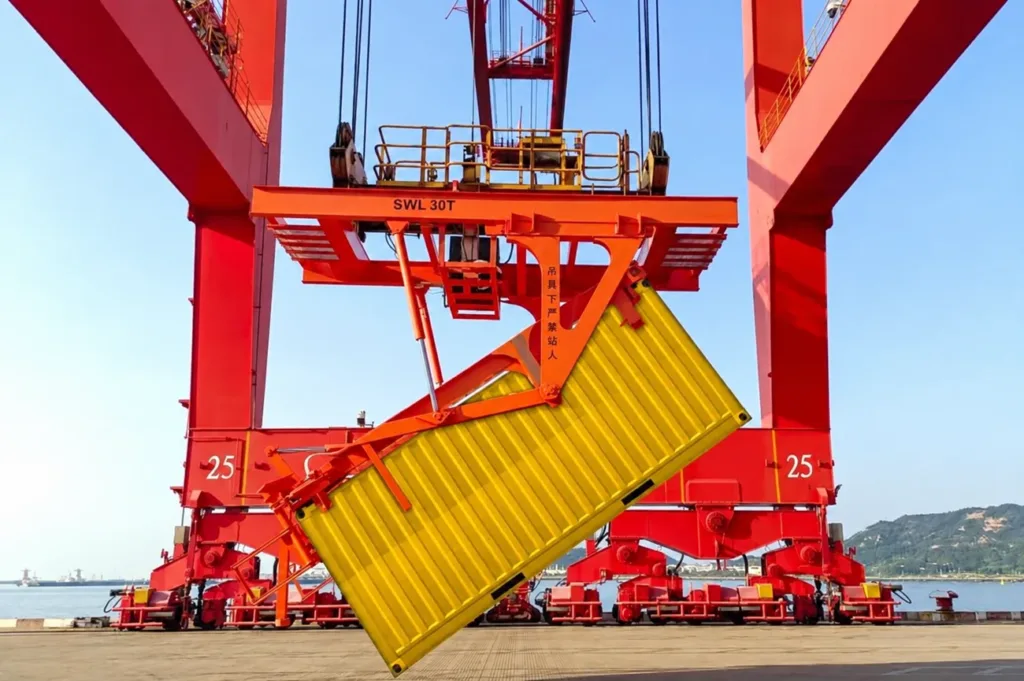
Tipping attachments
A dedicated mechanism tilts the container to discharge suitable bulk material into the receiving system.
Selection details
- Specify the container construction, discharge opening, material and maximum loaded weight. Ordinary container handling does not establish suitability for tipping.
- Include the hopper, rotation clearance, dust control and operating sequence. Confirm the complete load path and crane compatibility.
Check the connection
before the capacity.
A matching box length does not make a spreader a drop-in replacement. Send the existing drawings and nameplate with your enquiry.
| Suspension & load | Headblock, pin and lifting-point dimensions; spreader self-weight plus container gross weight; crane capacity at the operating radius where applicable. |
|---|---|
| Power & signals | Available supply, plug and pinout, cable handling, control protocol and required crane/spreader status signals. |
| Landing & locking | How landed, locked and unlocked states are detected and displayed; which movements are permitted in each state and how faults are handled. |
| Clearance & duty | Available hook height, flipper and rotation envelope, cycles, outdoor exposure and maintenance access. |
Define the assembly.
Agree the checks.
Keep the supplied attachment and its connection to the crane in the same specification.
- 01
Frame & locks
Frame, twistlocks, guidance and suspension. State whether rotation, twin separation or an overheight frame is included.
- 02
Control interfaces
Agree cabinets, cables, connectors, sensors and responsibilities for crane-side programming and commissioning.
- 03
Tests & records
Agree function, interlock and applicable load tests. Request drawings, instructions, spare-part identification and the specified inspection records.
01Can I reuse my existing headblock and electrical connector?
Possibly, after checking the drawings, pin dimensions, wiring and control functions. Similar appearance or the same connector shell does not establish compatibility.
02Does automatic locking mean the crane can operate unattended?
No. Automatic locking is an attachment function. Crane automation needs its own positioning, sensing, protective functions and operating design.
03What is the difference between twin-lift and tandem lifting?
Twin-lift commonly handles two 20 ft containers with one spreader using additional centre locks. Tandem arrangements use a different multi-spreader configuration. State the actual box arrangement rather than relying on the name alone.
04Which standards and materials should be specified?
ISO 1161 concerns container corner fittings, while ISO 3874 covers container handling and securing. They are not proof that a particular spreader is certified. Confirm applicable standards, material grade, coating and inspection documents for the supplied design and destination.
05Which spare parts should I plan for?
Ask for model-specific twistlocks, landing and position sensors, guide components, seals where applicable, and electrical connectors. Include inspection access and the replacement procedure.
Show us the crane.
List your containers.
Send the crane and existing spreader nameplates, interface drawings and photographs. For a new installation, include the proposed lifting arrangement.
Discuss container handling- Box lengths, maximum gross weight, single or twin operation, imbalance and any protruding cargo.
- Crane type, capacity, suspension drawing, headroom, available power and control interface.
- Cycles, box-spacing needs, environment, destination, tests and requested spare parts.