
Container Yard Cranes · RTG & RMG
Stack containers.
Connect the yard.
Container yard cranes move boxes between storage stacks and receiving vehicles or rail wagons. Compare rubber-tyred and rail-mounted layouts around your block plan, ground conditions and handoff points.
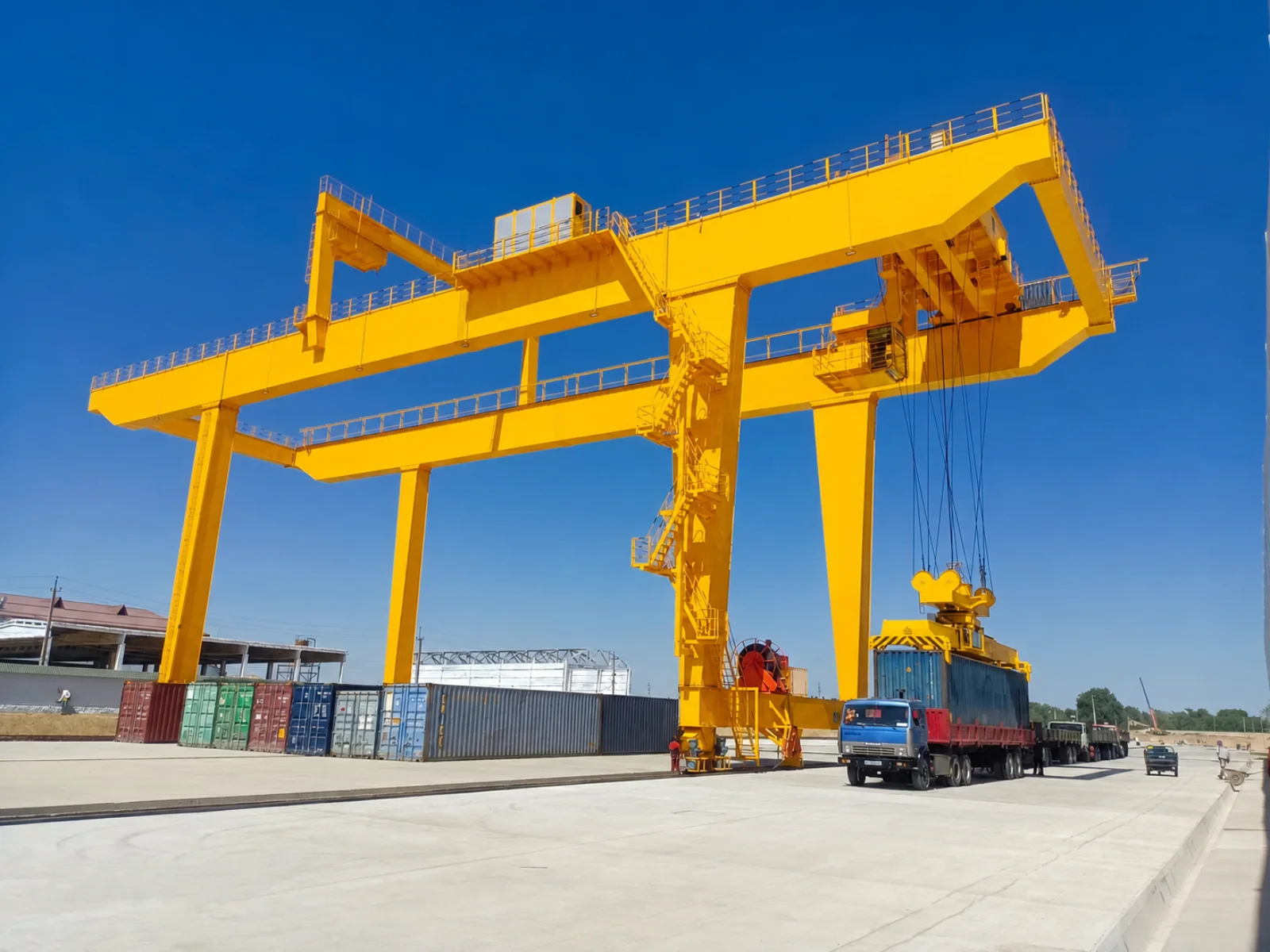
Work on tyres.
Or follow fixed rails.
Start with the yard layout and whether cranes need to change blocks. Neither arrangement determines the power source or level of automation by itself.
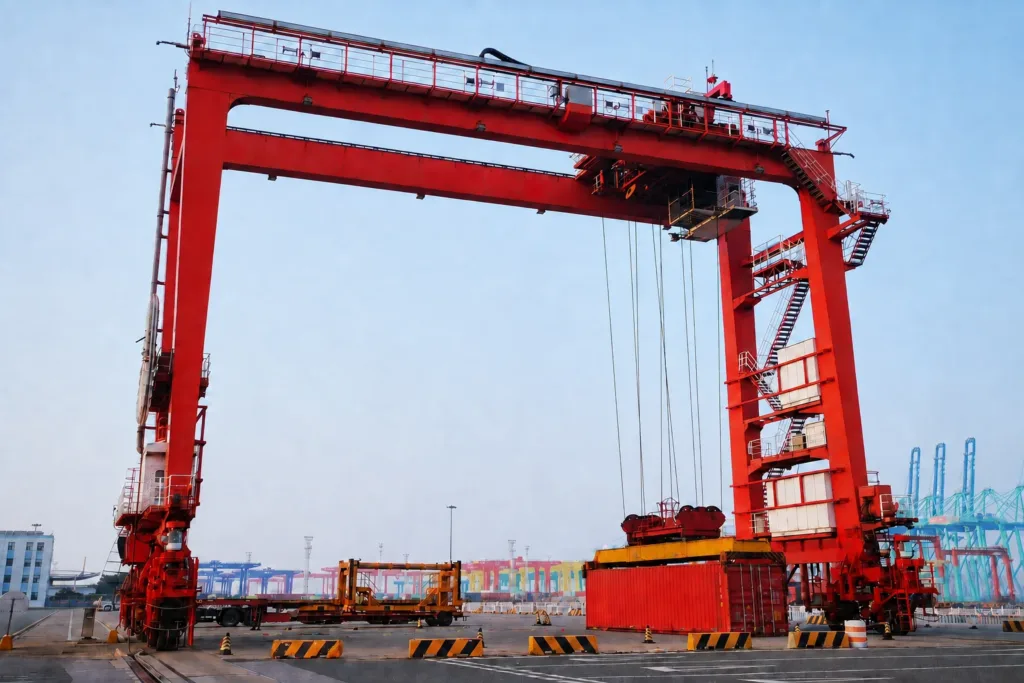
RTG container cranes
A tyre-mounted crane serves container stacks and transfer lanes without a fixed crane rail. It can be arranged for block changes where the yard route, steering and power system allow.
Check suitability
- Check wheel loads, pavement condition, gradients, turning space and clearances along the proposed route. No crane rails does not mean the existing ground is automatically suitable.
- Diesel-electric, hybrid, battery and grid-connected arrangements serve different operating plans. Cable or conductor supply needs a defined connection and block-change method; battery operation needs a charging plan.
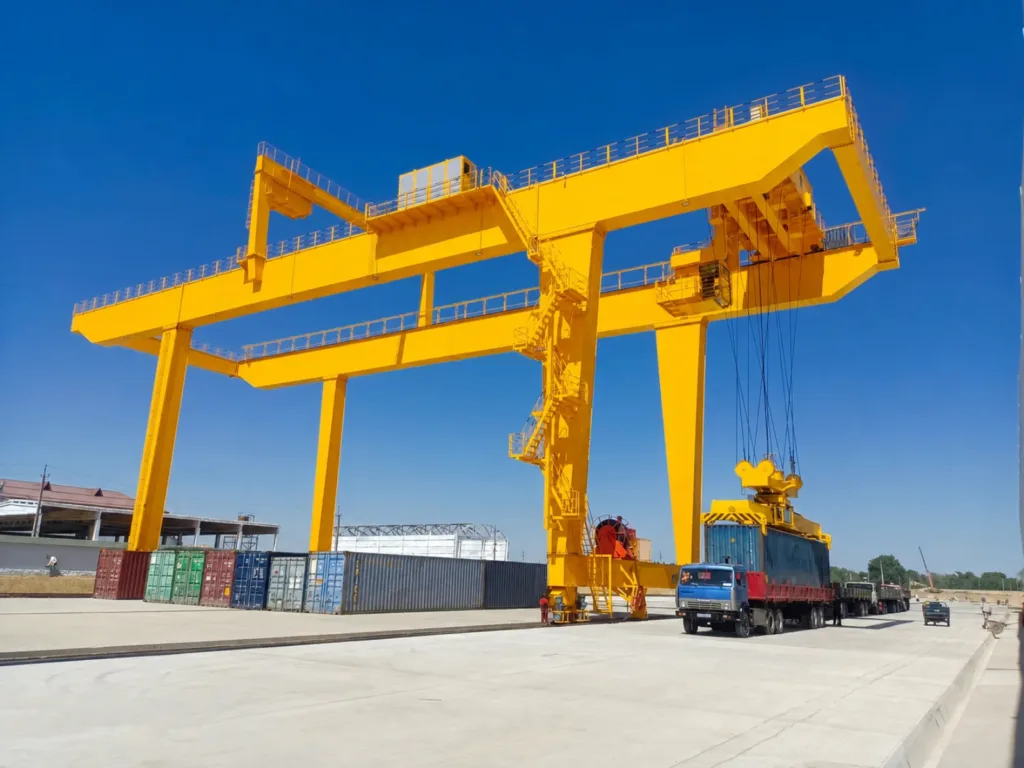
RMG container cranes
A rail-mounted crane follows a defined yard or intermodal track. Its span and any cantilever reach can serve storage rows, truck lanes or rail wagons within the planned operating envelope.
Check suitability
- Confirm rail gauge, alignment, foundation loads, travel limits and power routing. Fix the rail layout against the required stacks and transfer points before finalizing the crane geometry.
- Show receiving lanes, wagon positions and required container orientation. Select any spreader or trolley rotation from the actual handoff task; a cantilever or rotating arrangement is not included on every RMG.
Follow the container.
Check its surroundings.
Select a marker on this RMG example to see how the load, receiving vehicle and ground interface affect the installation.
Show the block plan.
Define the working cycle.
Storage capacity depends on usable rows and heights, but also on the lanes and space required to retrieve containers.
| Containers and stacks | Container sizes and loaded weights, required rows, stack heights and clearance to move a container above the stacks. Identify special loads or attachments. |
|---|---|
| Yard and support | Block dimensions, transfer lanes, rail tracks or pavement data, gradients, obstructions and any route between blocks. Include environmental and wind conditions. |
| Operating cycle | Operating hours, expected moves, travel distances, receiving vehicles or wagons and their arrival pattern. State where an operator or remote station will control the work. |
| Power and infrastructure | Available electrical supply, charging or fuel arrangements, crane travel distance and cable or conductor routing. Identify civil-work and commissioning responsibilities. |
01What should the equipment scope include?
Identify the crane, spreader, operating controls, power connection, positioning and protection functions, service access and initial spares. Separate equipment supply from rails, foundations, pavement, terminal-system interfaces, erection, training and commissioning responsibilities.
02What needs to be confirmed for remote or automated handling?
Specify the movements to automate, container and vehicle positioning, access control and terminal task interfaces. Agree operator intervention, exception handling and recovery. Remote operation and condition monitoring alone do not make a yard crane an automated stacking system.
Choose around the yard.
Avoid category assumptions.
Resolve the operating and infrastructure differences before comparing offers.
01Does an RTG have to use a diesel generator?
No. Grid-connected, battery and hybrid arrangements are also available. Compare the required energy supply with travel between blocks, charging or connection time and the actual working cycle. Confirm which combination is available for the selected equipment.
02Does a taller crane always create a more productive yard?
No. Higher stacking can increase storage within the same footprint, but container retrieval, reshuffles, travel and vehicle queues still affect output. Compare a usable yard layout and operating scenario, not stacking height in isolation.
03Can a yard crane load containers directly onto a ship?
RTG and RMG yard cranes are selected for storage and landside transfer. Vessel-to-shore handling requires a suitable quayside crane with its own reach, lifting envelope and berth design.
Need ship-to-shore handling?
Review vessel reach, quay support and landside transfer for the vessel interface.
View quayside cranesSend the yard layout.
Describe the moves.
Share the block plan and operating information available. We can review the equipment arrangement and the remaining inputs needed for a project proposal.
Discuss a yard crane- Sizes, loaded weights, stack plan and required handling clearance
- Block dimensions, lanes, rail or pavement information, power and site conditions
- Vehicles or rail handoff, working cycle, block changes and control requirements