
Standalone Electric Winches
Electric winches.
Lifting or pulling.
Motor-driven rope drums for specified lifting, hauling and positioning tasks. Match rope-end force, rope travel and mounting to the job. A pulling rating does not automatically qualify a winch for lifting.
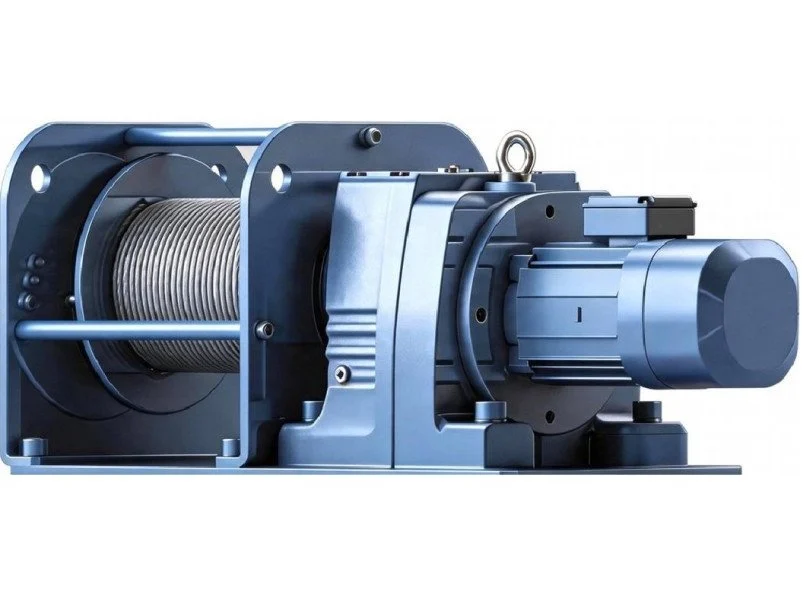
Compact drive.
Or a separate base frame.
These examples show two physical arrangements. The lifting or pulling duty, rope travel and available space determine which equipment is suitable.
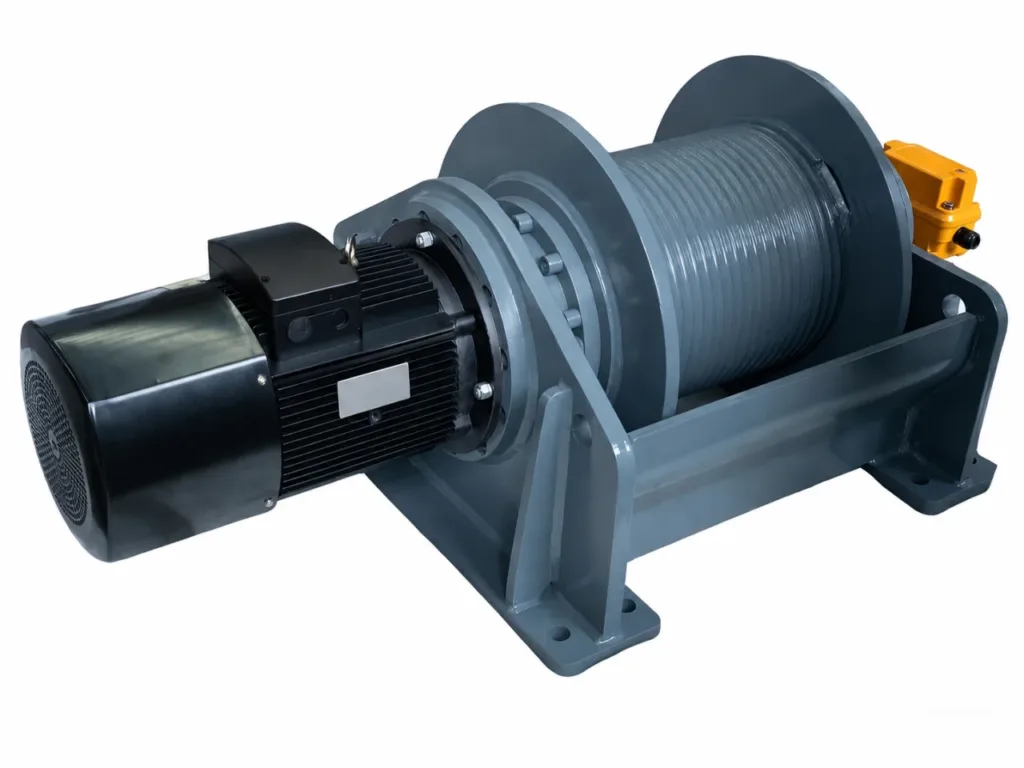
Compact geared winches
A compact motor, reduction drive and drum can fit into a machine or a dedicated mounting position. Check the complete envelope, including rope exit and service access.
Check suitability
- Show the rope direction and mounting position on a sketch. A compact winch still needs a suitable support and the rope-routing clearances specified for the selected equipment.
- State whether the load is suspended, positioned or hauled. Select the motor, gearing, brake and controls for the intended use and operating cycle; appearance alone does not establish suitability.
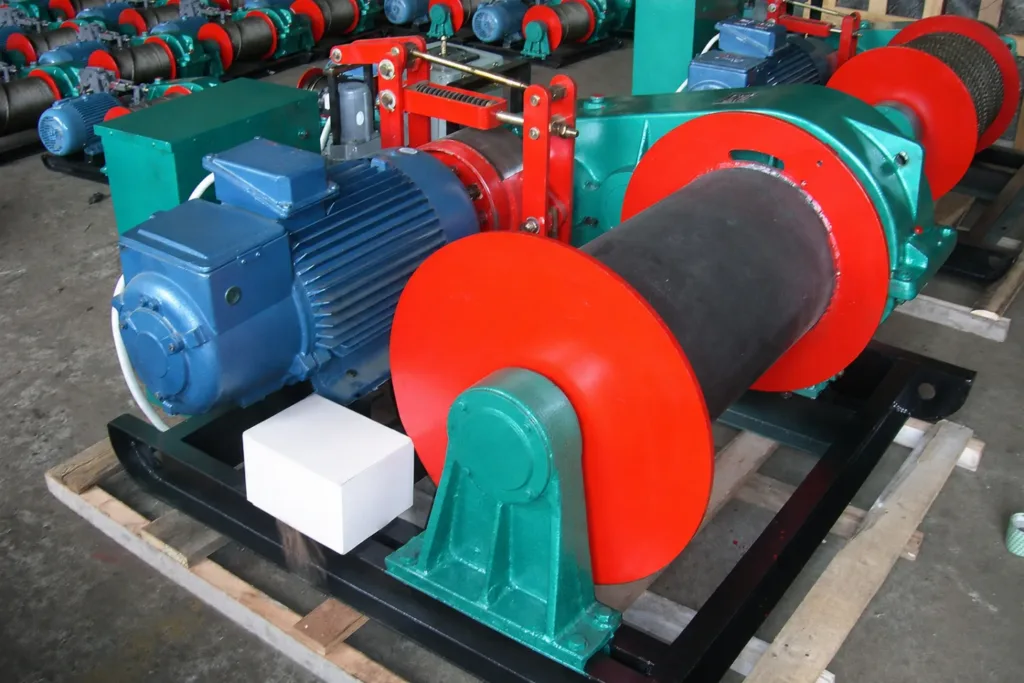
Base-frame industrial winches
A frame-mounted arrangement accommodates separate drive and drum components. The layout may suit a dedicated installation with room for inspection and servicing.
Check suitability
- Confirm the base dimensions, fixing arrangement and supporting structure. Leave access to the drum, drive and service items; the illustrated factory unit is not an installed guarding arrangement.
- Specify required rope-end force and speed at the working drum layer, together with usable rope travel. More rope storage does not by itself mean the winch meets the duty.
Follow the rope.
Check the installation.
Select a numbered area on this compact winch. The visible components help explain what must be specified; the photograph is not a model specification.
Start with the task.
Then define the pull.
A load weight alone is not enough to select a winch. The rope route, drum layer and operating cycle affect the required equipment.
| Lifting or hauling | Identify suspended loads separately from loads rolling or sliding along a surface. For hauling, include the slope and resistance to movement; handled mass is not the rope-end pull. |
|---|---|
| Force and working layer | Specify the required rope-end force and where it is needed in the winding cycle. If sheaves are used, review their effect on load, rope travel and speed. |
| Travel, speed and duty | State usable rope travel, operating speed, starts and running time. Include frequent positioning or slow operation rather than describing only the maximum load. |
| Site and controls | Provide available power, mounting and rope direction, indoor or outdoor exposure and required control location. Define stopping, limits and any machine interfaces for the selected use. |
01What is included with the winch?
Agree the winch, rope, controls and required protective functions explicitly. Sheaves, hooks or other attachments, support structure, fixings, guarding, installation and commissioning need a clear supply boundary; they are not automatically included in a winch quotation.
02What if the rope has to run through several sheaves?
Send the proposed routing and required load movement. The reeving arrangement changes the relationship between rope-end force, load movement and rope travel, while the winch and sheaves have their own routing limits. Review the complete arrangement against the selected equipment instructions.
Pulling capacity?
Check the intended use.
Resolve these points before comparing offers with apparently similar load figures.
01Can a pulling winch be used to lift the same weight?
Do not assume so. Confirm that the specific winch and installation are designed and rated for lifting, with suitable braking, controls and protective functions. A rope-end pulling figure is not a general suspended-load rating.
02Does the quoted pull apply to every rope layer?
Not necessarily. Many winch figures refer to a stated drum layer. As rope builds up, the effective radius changes; ask for the available force and speed across the layers used by your task.
03Is this the same as an Open Winch crane hoist?
This page covers separately mounted electric winches. An Open Winch crane-hoisting mechanism is selected as part of the crane lifting arrangement, with its trolley, reeving and crane interfaces. Use the dedicated page when specifying that equipment.
Looking for an Open Winch?
Explore open winch units designed around a crane lifting arrangement.
View Open Winch UnitsShow the load.
Draw the rope route.
Send the task and site information you already have. We can review the equipment arrangement and identify the missing inputs before preparing a proposal.
Discuss an electric winch- Lifting, positioning or hauling; load and movement conditions; required rope-end force if known
- Rope travel, speed, expected operating cycle and a sketch of the winch, load and sheaves
- Mounting space, available power, environment, control location and required supply scope